Issue 001 · Big questions, small beginnings
When two instruments agree
Three big ideas. One borrowed instrument. A question about what we can trust.
For curious readers, families and classrooms · Ages 10–14

A small instrument with a big job
A space elevator sounds like a story that should begin high above Earth. This one begins on a table.
Meridian researchers Mara Voss and Jonas Reed have borrowed a measuring instrument. It comes in a case. Soon, they will have to give it back.
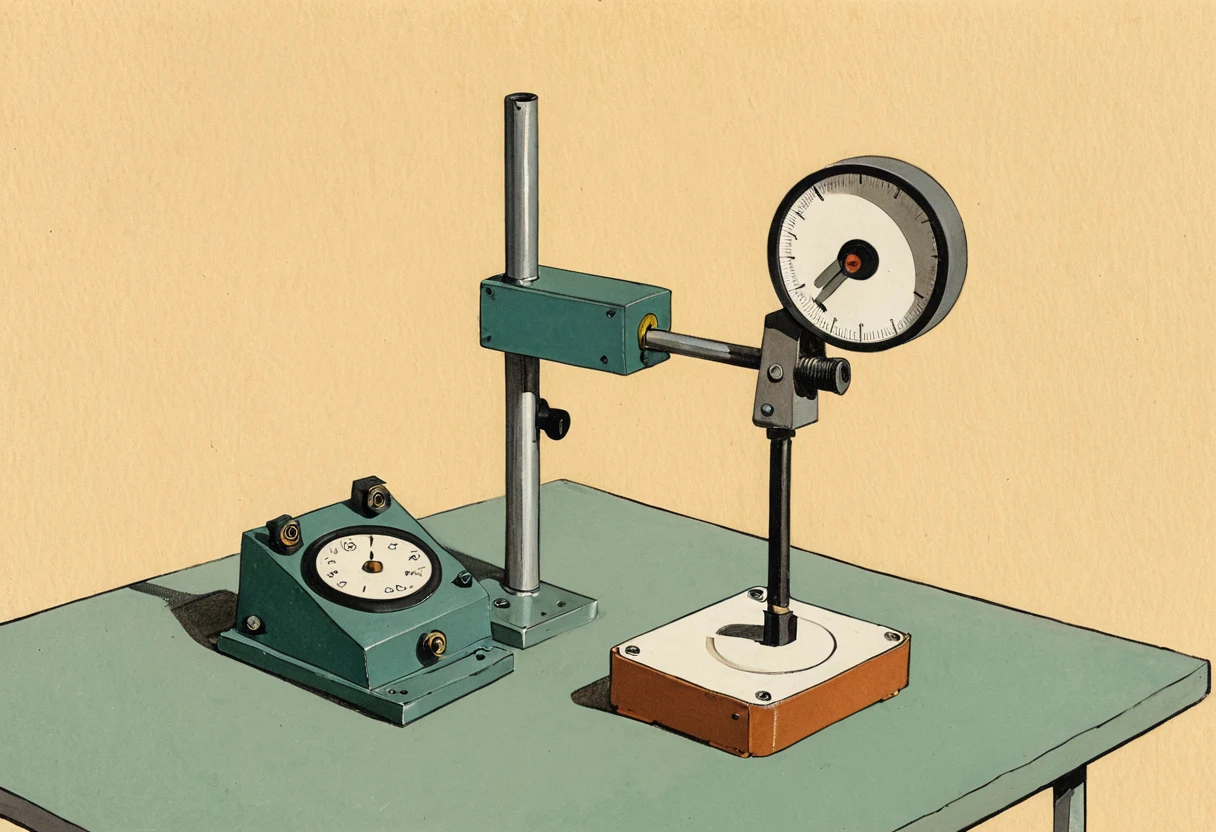
The instrument is called a comparator. A small contact touches an object, and a pointer shows tiny changes in position. It can help the researchers ask whether another instrument is telling the whole story.
Why does a space-elevator team need to know that? Because before you trust a material to carry something important, you need to trust the way you test it.
First, meet the three projects
A route into space. The Meridian Space Elevator Initiative is studying an enormous ambition: a long tether stretching from Earth into space, with electric climbers carrying cargo along it. A tether is a strong line that holds things together. This one would need a ribbon unlike anything the team can currently supply. Small carbon structures can have remarkable properties, but making a huge, reliable ribbon is a different problem.
If a space elevator ever became practical, it could change how supplies reach orbit. People would still need to decide where it belongs, who can use it, how it affects its surroundings and who is responsible when something fails. The team has no working elevator. Its present work is much smaller: learning how to measure movement before testing a strip of material under load.
Messages from the Moon. The Lumen Lunar Communications Initiative wants future lunar equipment and people to stay connected. Its proposed system would use light to carry messages, with radio and stored messages helping when a connection is interrupted.
A lost reply creates a surprisingly difficult question. Was a request never received, or was it completed before the reply disappeared? Sending it again could accidentally do the same job twice. Lumen is testing rules for recovering the earlier answer. Reliable recovery could matter to a rover sending results or a crew waiting to learn whether a command worked. The latest tests are computer models; they are not messages sent through a working Meridian Moon network.
Signals and perception. At the Noema Institute, Aletheia is the name of a proposed Psychic Amplifier Implant. An implant is a device placed inside the body. This project's ambition is especially speculative: it asks whether weak signals involved in thought or perception might become easier to distinguish while a person keeps control of their own judgment. The name describes an ambition, not a demonstrated ability.
Before that ambition can be tested, researchers need to ask whether their equipment could mistake its own activity for a new signal. In their latest computer study, two inputs behave simply when tested alone, but can produce an extra effect together. Subtracting the equipment's solo response would still leave some of that joint effect behind. The study uses invented numbers, not brain recordings. It provides no evidence of psychic abilities or a working implant. If any future device influenced perception, understanding its mistakes and protecting people's choices would matter as much as making it sensitive.
Back to the table: what actually moved?
Voss and Reed want eventually to measure how much a material stretches. But a reading can change even when the material is not stretching. A support might move. An instrument might change as it settles after being switched on.
For this comparison, there is no strip being pulled. The researchers watch an unloaded local target using two instruments:
KIS-61: the team's powered measuring head, held in its original bracket. NQ-17: the borrowed mechanical comparator, on a separate stand.
The instruments start at different numbers. That is fine: the question here is how much each reading changes from its own starting point.
| Minutes after power-on | KIS-61 change (µm) | NQ-17 change (µm) | Difference (µm) |
|---|---|---|---|
| 0 | 0 | 0 | 0 |
| 10 | 8 | 7 | 1 |
| 30 | 10 | 9 | 1 |
| 60 | 10 | 9 | 1 |
All changes in this table are in micrometres. One micrometre is one thousandth of a millimetre. These numbers come from Meridian's research record.
The instruments show almost the same change. That sounds reassuring. But both are watching the same target, in the same table environment.
Imagine two people standing on a bus. Both look at a bag on the floor and say, “It hasn't moved.” They can agree while the bus carries all three down the street. Their agreement answers one question: has the bag moved compared with them? It does not answer every question about movement.
The table comparison has a similar limitation. A small difference between the readings does not prove the target stayed still. The shared change could involve the target, its supports or the instruments' surroundings. This test does not yet tell the researchers which explanation is right.
What changed—and what has to wait
What changed: the team now has a second way to observe the target. Most of the measured change appears in both channels. That gives the next investigation something specific to explain.
What has to wait: declaring the bench ready to test a loaded strip. The team still needs to understand its reference arrangement and check measurement performance across the intended range. The comparator's small scale divisions do not, by themselves, prove how accurate it is.
The loan also gives the story a deadline. NQ-17 is due back on January 8 unless the loan is renewed. The next useful step must fit the equipment, time and people actually available.
Why these small questions matter
It is easy to picture the future machine: a climber carrying supplies into orbit, a lunar rover sending a message home, an instrument helping someone distinguish a faint signal.
The less visible work asks whether that climber's material test meant what people thought, whether the reply belongs to today's request, and whether a signal came from the thing being studied or from the equipment itself.
Those questions connect research to the people who might depend on it. They also leave room for people outside a laboratory to ask what a machine should do, who it should serve and when the evidence is good enough to take the next step.
Try thinking like a researcher
Two classmates copy an answer from the same worksheet. Their answers agree. Have you checked the answer twice, or checked two copies of one answer?
Now think about the instruments. Their mechanisms and histories differ, which is useful. What do they still share? What would you want a third observation to avoid sharing?
There is more than one useful answer. You could ask about the target, the table, the surrounding conditions or the reference used to judge movement. The important step is to say what your new check would help you learn—and what it would still leave uncertain.
Words to take with you
Comparator: an instrument that helps compare positions or sizes, often by showing small changes.
Reference: something you compare a measurement against. Its own limitations matter.
Model: a simplified system used to explore an idea. Here, some models are calculations carried out in software.
Interaction: an effect that appears when things act together and cannot be predicted just by adding their separate effects.
Next time: Follow the borrowed comparator's deadline, the search for a trustworthy “now” in Lumen's records, and the tests Aletheia needs when two inputs act together.
For families and educators
Meridian Research Collective is a research world. Its instrument observations are invented events within that world; its latest Lumen and Aletheia studies use authored software models. Possible futures are possibilities, not promises. This issue practices comparison, evidence, scale and the difference between an ambition and a result.
Follow the research
- Two readings of the same stillness
- Who keeps the current epoch?
- When the inputs stop adding
- What we are trying to build
Illustrations were generated locally with AI and selected for this issue; the data table is typeset from the research record.