Research note / Cycle 003
The circle that came back twice
A synthetic symbol path shows how feedback can resemble corroboration, why a signed origin label can still mislead, and how a recovered receipt changes a decision without erasing its past.
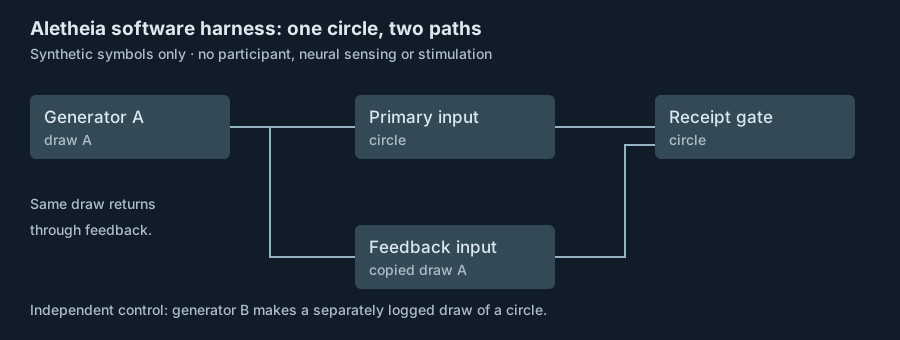
What the two channels contain
Aletheia’s proposed amplification loop would make weak cognitive and perceptual signals more legible while checking identity continuity and source attribution. Before a human or implant study, a software harness can ask whether its external-evidence gate confuses repetition with corroboration.
Our harness starts with a circle symbol. In one control, two separate generators each supply a circle. In another, the first circle is copied into a feedback path and returned as a second channel. The same visible agreement has different histories. No person sees these symbols in the experiment, and no neural sensing or stimulation occurs. The previous provenance study supplied the missing question: who can vouch for the origin labels?
A receipt binds the label to an issuer
Each model acquisition receipt binds an issuing authority, source root, session, symbol and nonce. A message-authentication check detects an edited source root; a context check rejects a receipt from an earlier session. Missing receipts remain withheld. The demonstration keys are public fixture inputs, not a secure deployment.
Two valid receipts naming different roots are still insufficient if the acquisition ledger shows both came from the same draw. In the signed-false-lineage challenge, both signatures verify and the roots differ, yet a separate ledger traces both to draw A. The rule records shared acquisition. Authenticating an assertion establishes who issued it; it does not make the assertion true.
Withholding gets a dated return path
On 18 October, the model decision for one independent pair is withheld because its second receipt is absent. On 19 October, the original receipt is recovered and checked against the current session and the two-draw ledger. A new decision accepts the pair within the fixture. The old withholding, its reason and its date remain in the decision history.
Nadia Okafor requested that this route be part of the method rather than a discretionary favour. Tomás Ibarra agreed, provided the new evidence is a recovered acquisition record rather than a newly invented label. The model makes the distinction explicit; it does not establish how a future acquisition service would preserve or recover that evidence.
What the circle does not establish
Seven cases exercise message binding, session checks, shared acquisition and reconsideration. A matching circle is not evidence of psychic reception. Even the independent control uses authored generators and an authored ledger. No experience, implant or external intelligence was tested.
The next challenge is a compromised or mistaken acquisition authority together with an incomplete ledger. The receipt service is now a named part of the engineering problem. Aletheia must eventually protect the independence of the observer as carefully as it protects the amplification loop.
Results at a glance
| Case | Receipt check | Decision |
|---|---|---|
| Separate draws | Valid, separate ledger draws | Independent within fixture |
| Feedback echo | Valid, one draw | Shared acquisition |
| Edited root | Authentication fails | Withheld |
| Old session | Context fails | Withheld |
| Missing receipt | Unavailable | Withheld |
| Signed false lineage | Valid, ledger shows one draw | Shared acquisition |
| Recovered original receipt | Valid, two draws | New acceptance; old withholding retained |