Research note / Cycle 003
Two copies of event five
A replay of twelve model receiver samples distinguishes a recoverable damaged record, an absent sample and two intact records that disagree about the same event.
From incoming light to a replayable event
Lumen’s proposed optical base would receive light, convert it into detector measurements and process those measurements into useful traffic and acquisition information. This study concerns preserving a receiver’s observation history alongside adaptive processing. It does not test the transmitted message or the performance of a laser link.
Our software stream contains twelve labelled photodiode samples, numbered zero through eleven and spaced 100 milliseconds apart. The sample names are synthetic payloads, not measured photocurrent. Each archive copy carries the sequence number, acquisition time, payload and a checksum over those fields. The earlier archive-loss study assumed those identities and contents were trustworthy. Here we deliberately damage them.
An intact record can still disagree
Changing archive A’s event-five identifier to six leaves its retained checksum inconsistent. The replay rejects that record and recovers event five from B; all twelve events remain usable. This is the case where redundancy delivers the recovery Chen wants.
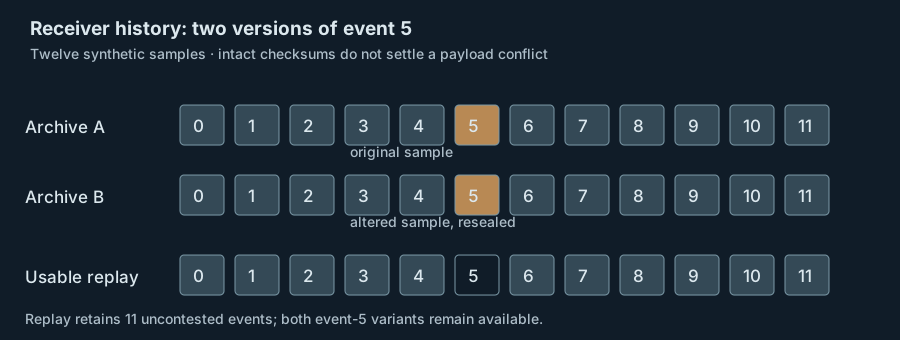
A different case changes B’s event-five payload and recomputes its checksum. Both copies are internally intact, but they disagree. Replay keeps both variants for inspection and excludes event five from the uncontested stream. Eleven events are usable. Nothing in a checksum tells us which version describes the source.
That differs from the shared-loss case, where both archives lack event five altogether. There are again eleven events, but now there is no competing version to inspect. The report separates missing from disputed. It also preserves two distinct event IDs when their payloads happen to be equal: a steady detector reading is not a duplicate event merely because its value repeats.
The clock walks away from its first comparison
In the timing example, a local clock reads 7 milliseconds at reference time zero and 1,017 milliseconds at reference time 1,000. A sample stamped 512 belongs at reference time 500 in the authored linear model. Subtracting only the starting offset places it at 505; using both synchronization witnesses places it at 500.
This correction assumes linear drift between those witnesses. A clock could wander and return between the endpoints. The next replay should test that possibility and avoid extending a correction beyond its observed interval.
A useful replay must show what it cannot settle
Elias Chen accepts the eleven-event uncontested stream as useful, provided the quarantined variants remain accessible. Leila Haddad asks for the conflict to appear beside the stream rather than in a success total’s footnote. They agree on a report with three separate fields: recovered events, missing events and conflicting events.
These are six deterministic software cases, with retained checksums and authored clock witnesses. No detector, terminal or lunar path was operated. The next engineering question is how the receiver creates and protects its first record before either archive copies it.
Results at a glance
| Challenge | Usable events | What remains |
|---|---|---|
| Intact control | 12 / 12 | No gap or conflict |
| Changed sequence ID | 12 / 12 | One damaged record rejected |
| Resealed payload conflict | 11 / 12 | Two versions of event 5 retained |
| Both copies lose event 5 | 11 / 12 | Event 5 missing |
| Equal payloads, different IDs | 12 / 12 | Both events retained |
| Linear clock drift | 12 / 12 | Sample corrected from 505 to 500 ms |