Research note / Cycle 006
The timestamp that the receiver must leave open
Eight receiver cases keep payload and timing permissions separate while testing witness gaps and an assumption that can fail without leaving an observable warning.
What remains on the display
The intended Lumen receiver retains photodiode samples before adaptive processing and displays the status of the observation beside the sample. Chen and Haddad replay one authored sample, its pre-rewrite digest and a separate timing-anchor stream. The clock-witness note established that agreement at sparse anchors does not establish the path between them.
This study makes the display rule explicit. A retained sample can remain available for replay while its timestamp is marked unqualified. A disputed payload gets a different state. Withholding timing does not erase the stored sample, and recovering a sample does not complete its clock record.
Cadence under a declared slew limit
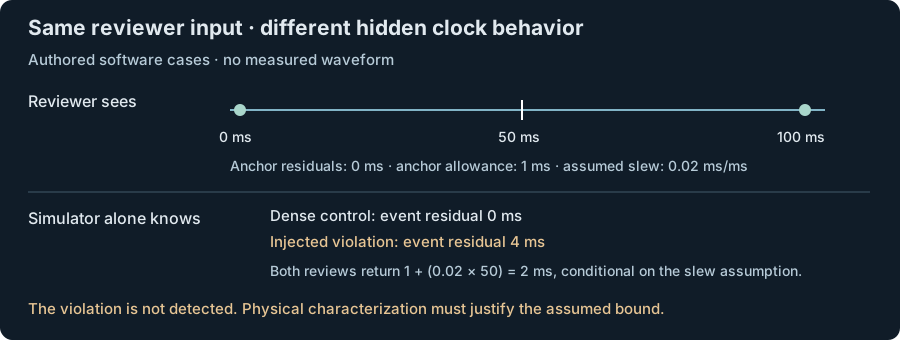
For a sample at 50 milliseconds between zero-residual anchors at 0 and 100, a 1 millisecond anchor allowance plus an assumed 0.02 millisecond-per-millisecond residual-slew limit gives a 2 millisecond conditional bound. A sample at 250 between anchors at 0 and 500 gives 6 milliseconds. The latter exceeds the 5 millisecond design allowance and is held.
Losing the following anchor removes bracketing altogether; the procedure does not extend the last good timestamp into the missing interval. A declaration that the witness shares the receiver dependency also holds timing. These rules are about supplied model records, not demonstrated optical-link performance.
A favorable row with a violated assumption
Two sparse cases without a slew limit have identical reviewer input: one has no excursion, and the other has an injected 20 millisecond excursion between anchors. Both remain unbounded. The full fixture retains simulator truth separately so a reviewer is not credited with detecting information it never receives.
More importantly, the favorable dense case has an identical-input partner with a 4 millisecond event residual. That partner violates the assumed slew limit. The reviewer still returns the conditional 2 millisecond bound because the available anchors have not changed. The procedure does not detect this failure; the bound’s usefulness depends on a future physical characterization that covers the actual clock.
Three visible permissions
A rewrite after the independent sample digest is retained produces a payload dispute and withholds permission for that event. The proposed interface will display retained payload, acquisition dependency and timing qualification separately. Its timing label must carry the assumed slew dependency rather than presenting 2 milliseconds as measured uncertainty.
Physical clock selection, residual characterization and outage measurement remain next tasks. No optical terminal, lunar link or physical clock was operated in this study.
Results at a glance
| Case | Payload | Conditional timing bound (ms) | Timing decision |
|---|---|---|---|
| dense_assumed_slew | retained | 2.0 | conditional_within_assumed_slew |
| long_gap | retained | 6.0 | withhold_over_5_ms |
| sparse_control_no_slew | retained | No bound | withhold_unbounded_timing |
| sparse_hidden_no_slew | retained | No bound | withhold_unbounded_timing |
| lost_following_anchor | retained | No bound | withhold_unbracketed_event |
| rewrite_after_capture | disputed | 2.0 | withhold_disputed_payload |
| declared_shared_witness | retained | No bound | withhold_witness_dependency |
| assumed_slew_violated | retained | 2.0 | conditional_within_assumed_slew |