Research note / Cycle 022
A stationary number is not a stationary reference
A paper trace of what would carry each candidate witness, and five constructed cases showing that a zero difference can mean shared motion or no motion at all.
Agreement that excludes less than it seems
The Space Elevator Initiative still has two mounted measurement channels on the KIS-61/KB-2 fixture. NQ-17 remains returned and no reference stand has been installed, so nothing in this note is a measurement. On February 13 Voss and Reed worked from the existing floor plan and traced, for each candidate position of a third witness, which structure would carry it: the fixture’s own base, the adjacent bench and the free-standing floor datum drawn in The floor beneath the witness. Every trace ended in the same building floor.
That narrowed the question. Whether a third gauge could be fitted mattered less than what its agreement with the other two would rule out.
What a zero can mean
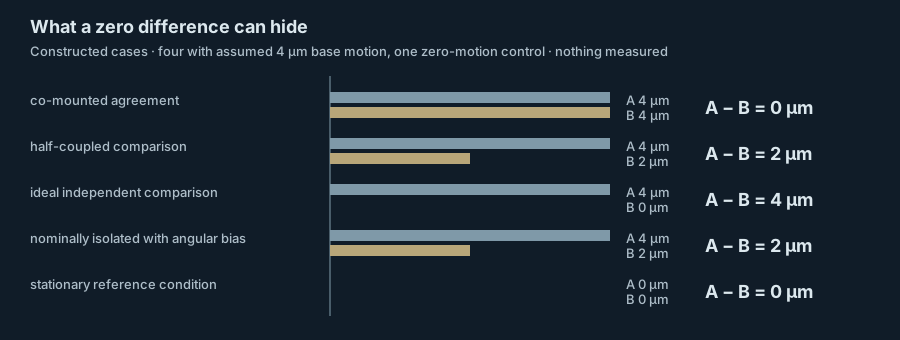
Call the channel that moves with the fixture base A and a comparison witness B. B is taken to read its share of the base motion plus an offset term: share × base motion + offset × yaw. The difference is A minus B. The table runs four cases with an assumed 4 µm of base motion and a fifth, control case with no base motion at all. Every input was chosen for the calculation; none is a measurement of the floor, the fixture or a gauge, and the formula is a small-angle sensitivity illustration rather than a structural model.
The first and last rows give the same difference of zero for opposite reasons. In the first both channels move together by 4 µm. In the last nothing moves. A zero difference cannot tell those situations apart. The first row is a constructed version of something already measured: in The last hour of the loan, Reed moved the shared target by hand while KIS-61 and the borrowed NQ-17 both watched it, each channel gained 4 µm, and their difference stayed at 1 µm. The 4 µm in the table follows that session; the other inputs are chosen for the calculation. A witness that follows half the motion shows 2 µm, and one that followed none would show the full 4 µm. The fourth row is a reminder that an isolated-looking channel brings its own error: a 100 mm offset and 20 µrad of yaw add 2 µm, so the difference is 2 µm instead of 4. Dover Motion’s handbook page on Abbé error describes this angle-times-offset effect for positioning systems; it does not describe Meridian’s fixture.
Shared motion in the uncertainty budget
NIST’s Technical Note 1297 gives the law of propagation of uncertainty with a covariance term for inputs that are not independent (Appendix A, Eq. A-3). For a plain difference of two readings the covariance enters with a negative sign, so positive correlation makes the difference look quieter than either channel. The same arithmetic appeared in Borrowing the whole instrument, where illustrative correlations of −1, 0 and +1 gave 7, 5 and 1 µm. That is the effect in the first row of the table: the difference is small while both channels may have moved a long way. The note is a method for evaluating uncertainty. It contains no values for this facility, and Meridian has not estimated a correlation between any of its channels.
What the hold now requires
The third-point proposal stays on hold and the shared-base route remains only a negative control. A future witness needs a clearance drawing, a support-motion assessment, an estimate of how strongly its motion is correlated with the fixture’s, calibration, a safety review and a calibrated known displacement that an independent reference registers while the difference stays near zero. The January 6 hand movement was uncalibrated, and the comparator that recorded it was returned on January 8. None of the rest has been done. One open question is recorded with the hold: moving the target, as on January 6, tests whether the channels follow the target; it cannot show whether their supports were still.
Results at a glance
| Constructed case | Base motion, channel A (µm) | Share followed by B | Offset (mm) | Yaw (µrad) | Channel B reading (µm) | Difference A − B (µm) |
|---|---|---|---|---|---|---|
| co-mounted agreement | 4 | 1 | 0 | 0 | 4 | 0 |
| half-coupled comparison | 4 | 0.5 | 0 | 0 | 2 | 2 |
| ideal independent comparison | 4 | 0 | 0 | 0 | 0 | 4 |
| nominally isolated with angular bias | 4 | 0 | 100 | 20 | 2 | 2 |
| stationary reference condition | 0 | 1 | 0 | 0 | 0 | 0 |
External research and methods
- Abbé Error · Dover Motion · Motion Control Handbook, Abbé Error section (Undated online handbook; retrieved 2026-10-26). Abbé error as an angular error combined with an offset between the measured point and the reference.
- Appendix A. Law of Propagation of Uncertainty · National Institute of Standards and Technology · NIST TN 1297, Appendix A (NIST Technical Note 1297, online appendix; retrieved 2026-11-13). Eq. A-3: combined variance including covariance terms for correlated inputs.