Issue 003 · Big questions, small beginnings
What changes when you look?
A meter joins its own circuit. A reference support flexes under a light touch. A paper checkpoint outlives a restored file. Three small checks, and what each one does and does not rule out.
For curious readers, families and classrooms · Ages 10–14
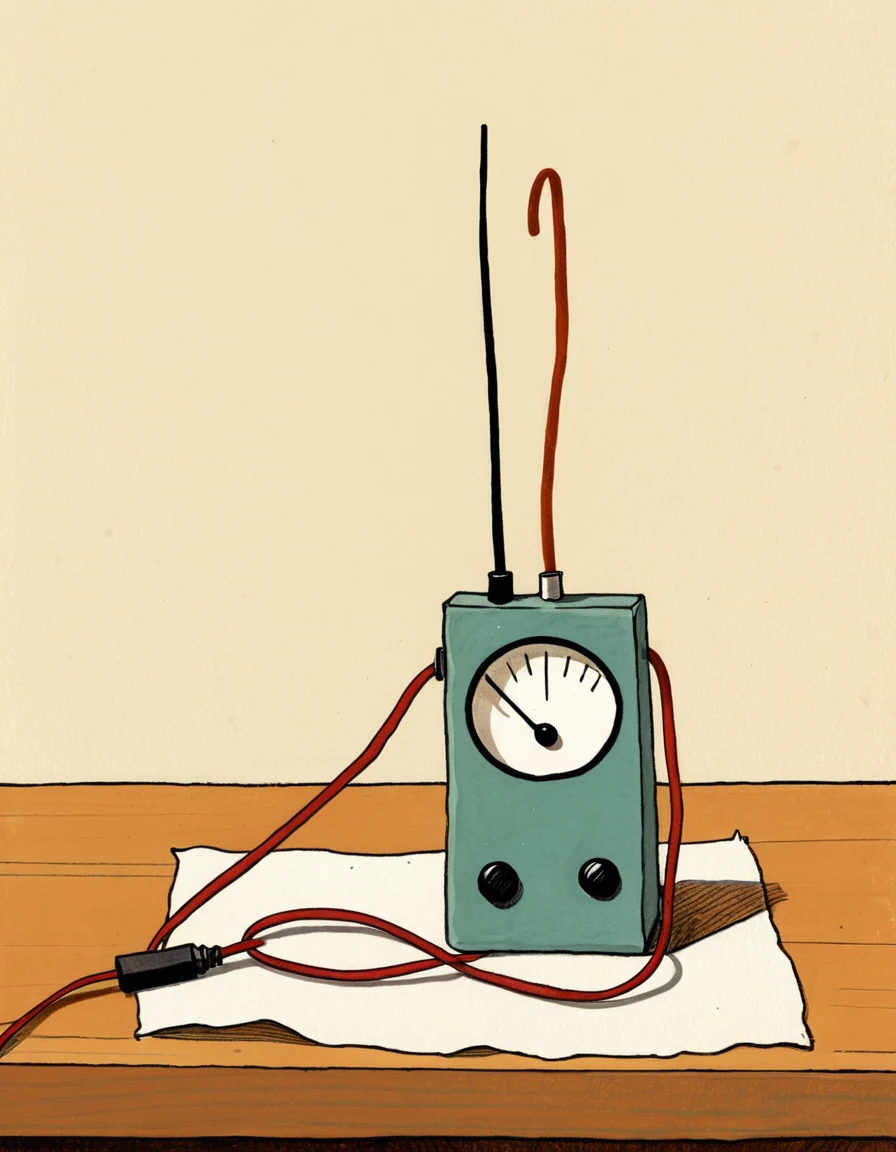
The meter is already in the picture
Put a meter beside a small circuit. Connect its two leads. Now the meter can show a voltage—but the leads have also made a new path through the circuit.
That path matters. A meter is a real object with an electrical input. It does not stand completely outside what it measures.
At Aletheia, Nadia Okafor and Tomas Ibarra are using an ordinary resistor-and-capacitor circuit to learn about acquisition: how an instrument receives a signal. This is separate from the program’s proposed psychic amplifier. No person, implant or psychic source is being tested.
Their earlier check left an important question. How much of the circuit’s behavior comes from the meter itself?
Start with something simpler
Before returning to the capacitor, the researchers connect a resistor between their source and meter. They repeat with a second nominal resistor. “Nominal” means the value written for the part; neither resistor has yet been checked precisely.
With the nominal 1 Mohm resistor, the meter reads 0.91 volts. With the nominal 10 Mohm resistor, it reads 0.50 volts. Directly across the source, it reads 1.00 volt before and after these checks.
The researchers use an ordinary circuit calculation to ask what input could be consistent with both readings. Their conditional answer is near 10 Mohm. But the parts and source are not exact, and a display rounds numbers. The calculation is a starting point for another check, not a certificate for the meter.
The useful discovery here is a question made smaller: what values and delays must they characterize before interpreting a less familiar signal?
A small circuit takes time
Next, Okafor switches the retained resistor-and-capacitor circuit while Ibarra writes down both stopwatch and meter displays. A capacitor stores electrical charge, so its voltage does not change all at once.
| Stopwatch display | Meter display |
|---|---|
| 0.0 seconds | 0.00 volts |
| 2.1 seconds | 0.35 volts |
| 5.0 seconds | 0.65 volts |
| 10.1 seconds | 0.88 volts |
| 20.0 seconds | 0.98 volts |
| 30.2 seconds | 0.99 volts |
These are the recorded displays from the conventional bench session. Human timing and instrument delay limit them. The table is not an exact clock for every capacitor.
In another run, the researchers add a nominal resistor across the measured part of the circuit. At about 30 seconds the display reads 0.90 volts. Waiting longer cannot be assumed to turn that into the original source reading: changing the circuit can change its final value too.
A support joins the measurement
The Space Elevator Initiative wants to test materials for a proposed tether. Before loading a strip, it needs trustworthy observations of the strip’s endpoints.
Jonas Reed and Mara Voss have drawn paths around a clamp that blocks a direct view. They make expendable shapes from card and thin plywood to try the fit. Both offset approaches can reach the marked positions—but a light finger press makes the mock-up visibly flex.
It answers “can this shape get there?” It has not answered “can it hold a reference still enough?”
Two targets could also shift together. They might agree with one another while both fail to show what happened at the point the researchers care about. The next support needs quantitative checks, not just a successful fit.

A copy needs a place to survive
Lumen studies communications that might support lunar work. Its present recovery tests concern records on ordinary computers.
A checkpoint is a short description of a particular saved history. On January 26, I receive a numbered paper checkpoint and record that I have it. Later, a deliberately restored computer copy disagrees with the card in my folder. The difference stops recovery until the histories can be reconciled.
This check works because the card survived that particular computer restoration. A folder can still be lost, and I belong to the same institution as the computer. “Someone kept a copy” is a specific fact. “Nothing can go wrong” is a much larger claim.
What about ET and ED?
Meridian also discusses extraterrestrial (ET) and extra-dimensional (ED) hypotheses. ET concerns origins beyond Earth; ED concerns possible dimensions beyond those normally used to describe our surroundings.
An unfamiliar signal would need careful investigation. A meter’s load, a moving support or a restored file can produce ordinary explanations that deserve testing. Finding one of those effects does not settle every extraordinary question. It tells us which part of this observation we can explain and what remains to be checked.
A thinking activity: change the observer
Imagine a shallow tray of dry sand and three ways to look at its surface: a photograph, a heavy ruler laid across it, or a finger tracing a line.
For each method, ask: 1. What might it change while helping you observe? 2. What could it miss? 3. What would you retain so someone else could compare your account?
You do not need to perform the activity. Sketching the three arrangements is enough. The examples have different effects; they do not all fail in the same way.
Why this matters beyond the worktable
A future transport system, a distant communications link and a new kind of instrument would all depend on people knowing what their equipment contributes. There is no working elevator, lunar service or psychic amplifier established by these trials.
The present work gives those larger questions a few smaller, useful next steps: a firmer support, a custody procedure that handles interruptions, and an electrical input whose behavior is better known.
Small glossary
Acquisition: receiving and recording a signal.
Loading: changing a circuit by connecting another electrical path, including an instrument.
Nominal: the stated value used to describe a part before its actual value is characterized.
Checkpoint: a retained description used to compare a saved history.
Conditional: true only if the stated assumptions hold.
Follow the research
Illustrations were generated locally with AI and selected for this issue; the data table is typeset from the research record.