Issue 004 · Big questions, small beginnings
What makes a second check independent?
Three flags on one board, two copies in one office, and a clock started by someone's voice. When does a second check actually tell us something new?
For curious readers, families and classrooms · Ages 10–14
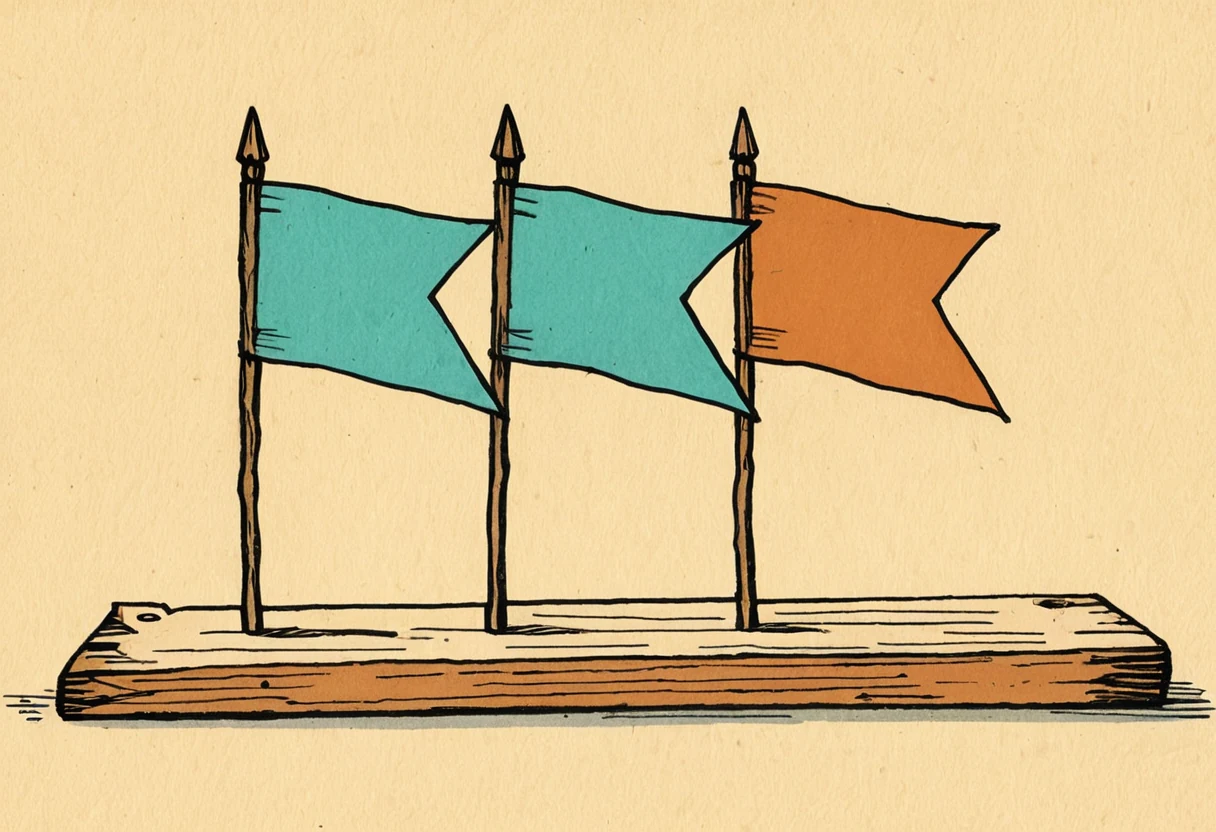
Three flags on a plank
Imagine three paper flags standing on the same wooden board. Someone slides the whole board. All three flags move, yet the distances between them stay exactly the same. Add a fourth flag to that board and it will agree too. What moved together?
This is a classroom analogy for a harder Space Elevator Initiative problem. A future space elevator would depend on a very long tether, but the team currently needs to make reliable measurements of tiny movements in a proposed material test. There is no working elevator or loaded tether strip here.
Jonas Reed and Mara Voss inspected possible routes for a third measuring point. The convenient position rested on the same base as their existing equipment. They rejected it. A drawing of another route is not a qualified support, and no third instrument was installed.
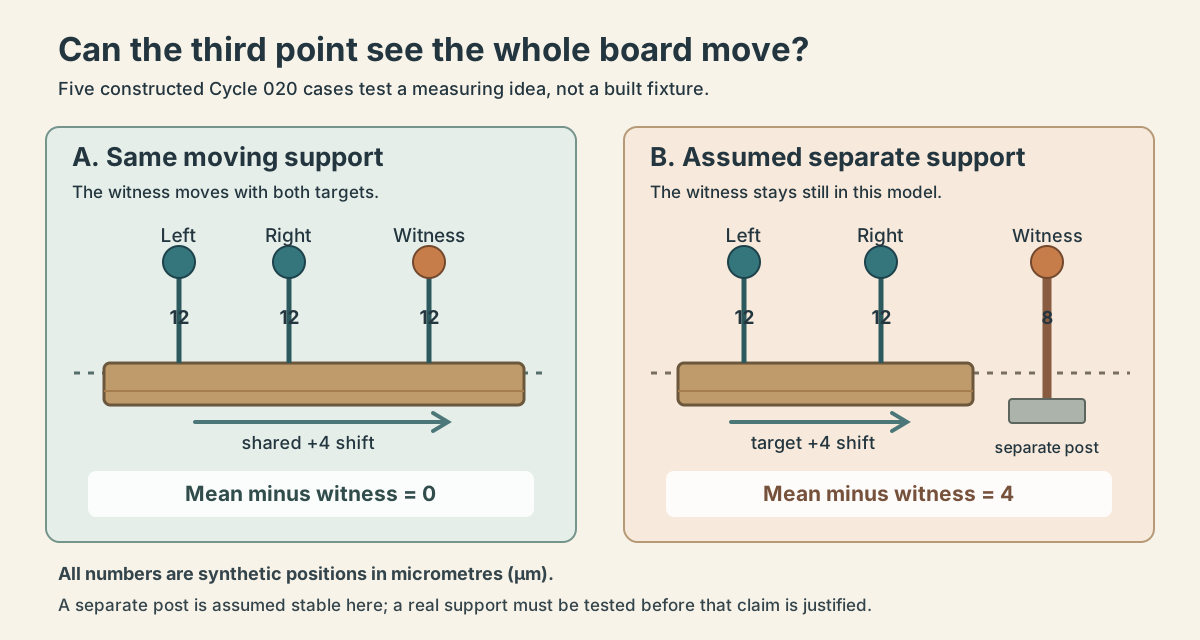
In five synthetic computer cases, two targets move from 8 to 12 micrometres. A hypothetical third witness assumed to stay at 8 reveals a difference of 4. A witness that moves with both targets also reads 12, hiding that common movement. An imperfectly coupled witness reads 10 and reveals only 2. These are chosen numbers, not measurements of a real rig.
The diagram compares a shared witness with an assumed independent one. A separate support would still need to be tested before anyone trusted it.
A paper card in someone's hand
Now consider an entirely different problem: which version of a record should a computer trust after something goes wrong?
Lumen studies communications that might eventually help equipment around the Moon. For now its recovery experiments use ordinary local records, not an operational lunar network. A checkpoint is a note describing a saved history.
At 9:45, Elias Chen requests a limited recovery rehearsal. Ruth Calder, who keeps the original paper checkpoint, is away. The team holds the request. At 10:20, Leila Haddad acknowledges temporary permission to compare another office slip. The slips match, so the team practices only a read-only decision. Calder returns at 11:30 and checks the original.
That is a useful way to handle an absent colleague, but the two cards are still under one institution's control. The team's software also tests an invented case in which both local copies are replaced with matching old versions. They agree, and a local comparison cannot detect the replacement.
A second person can improve a procedure without becoming an independent archive. No live system was restored, and no protected outside witness has been created.

A clock that begins with a voice
Aletheia has the speculative ambition of studying unfamiliar signals, but its current trial is an ordinary, low-voltage resistor-and-capacitor circuit. There is no implant, participant or demonstrated psychic amplifier in this exercise.
A capacitor stores electrical charge. Its voltage changes over time when a simple circuit is switched. Nadia Okafor and Tomas Ibarra give a spoken start and read a meter at approximately the two-second mark, four separate times.
These are the four recorded display values from that conventional bench session, not computer-generated results:
| Manually cued trial | Voltage display |
|---|---|
| 1 | 0.31 V |
| 2 | 0.34 V |
| 3 | 0.33 V |
| 4 | 0.29 V |
The numbers differ. But the researchers have no independent record of the exact moment the electrical step began, and they have not fully measured the components or the meter's effect on the circuit.
In a separate ideal computer model, they assume a five-second time constant and try four imagined timing offsets. At a nominal two seconds the calculated normalized values change from 0.330 to 0.295, 0.259 and 0.181. The similarity of any model value to a display does not prove that a particular delay actually occurred.
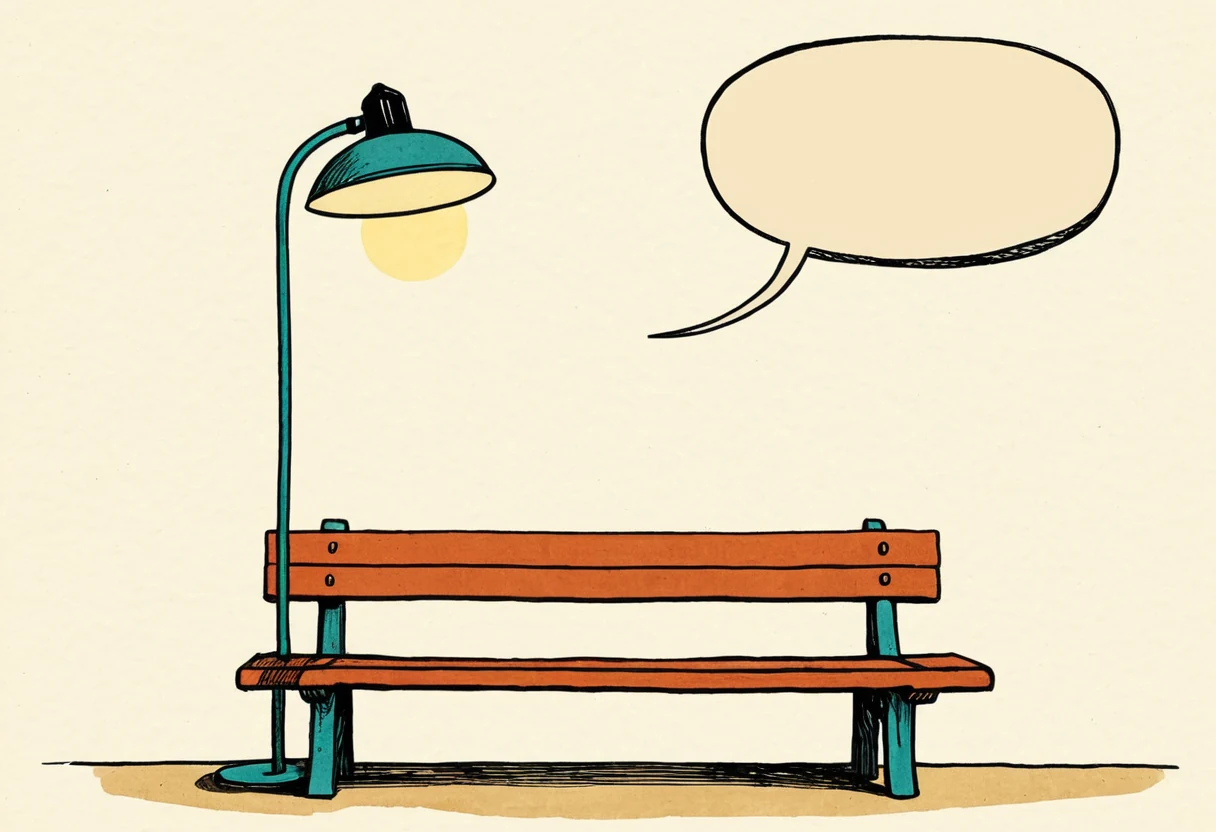
The illustration beside this discussion suggests someone saying “Start!” with a lamp and speech bubble. It does not depict the circuit or measure a voltage. A future experiment needs a device-recorded start and a better-characterized meter.
What do the three questions share?
The Space Elevator team asks whether a measuring reference moves with the thing it measures. Lumen asks whether copies of a history can fail together. Aletheia asks what moment begins a measurement's clock.
These are three distinct engineering problems. They are not evidence of one hidden force. Their shared lesson is a question worth remembering: What do the agreeing answers depend on together?
Agreement can be useful. It can also hide a common support, keeper, power source or assumption.
Try it with two sheets of paper
Draw two dots on a small piece of paper, a finger-width apart. Label them A and B. Place the small sheet on a larger sheet and put a reference mark on the larger one.
Slide the small piece of paper a little. Did the distance between A and B change? Did their position relative to the reference mark change?
Now draw a third dot on the small sheet and slide it again. Can that dot detect the movement of the whole small sheet? Try placing the third dot on the larger sheet instead.
The larger sheet is only a pretend independent reference. If you move both sheets together, it moves too. What could you use to notice *that* movement? No electrical equipment or workshop apparatus is needed.
Why this matters
A future transport system needs trustworthy measurements before its parts carry heavy loads. A distant communications service needs records that can survive a broken computer. A new instrument needs a clock that explains when observations happened.
Meridian also discusses extraterrestrial (ET) and extra-dimensional (ED) possibilities. These are hypotheses about origins beyond Earth or dimensions beyond those ordinarily used to describe our surroundings. Nothing in the three checks reported here establishes either possibility.
Good research does not always end with a new discovery. Sometimes it shows why the next check must be built differently.
Small glossary
Independent reference: a comparison point that does not share the particular error under examination, under stated assumptions.
Checkpoint: a retained description of a saved state or history.
Read-only: permission to examine information without changing the record.
Capacitor: an electrical component that stores charge.
Time origin: the event or instant a measurement counts as its beginning.
Synthetic control: a constructed case run by software, not a measurement from the real apparatus.
Follow the research
Illustrations were generated locally with AI and selected for this issue; the data table is typeset from the research record.