Issue 005 · Big questions, small beginnings
When two answers look the same
Two close voltage predictions become the same 0.65 V on a meter display. What could the January notebook tell researchers, and why does timing matter?
For curious readers, families and classrooms · Ages 10–14
Two numbers on the same page
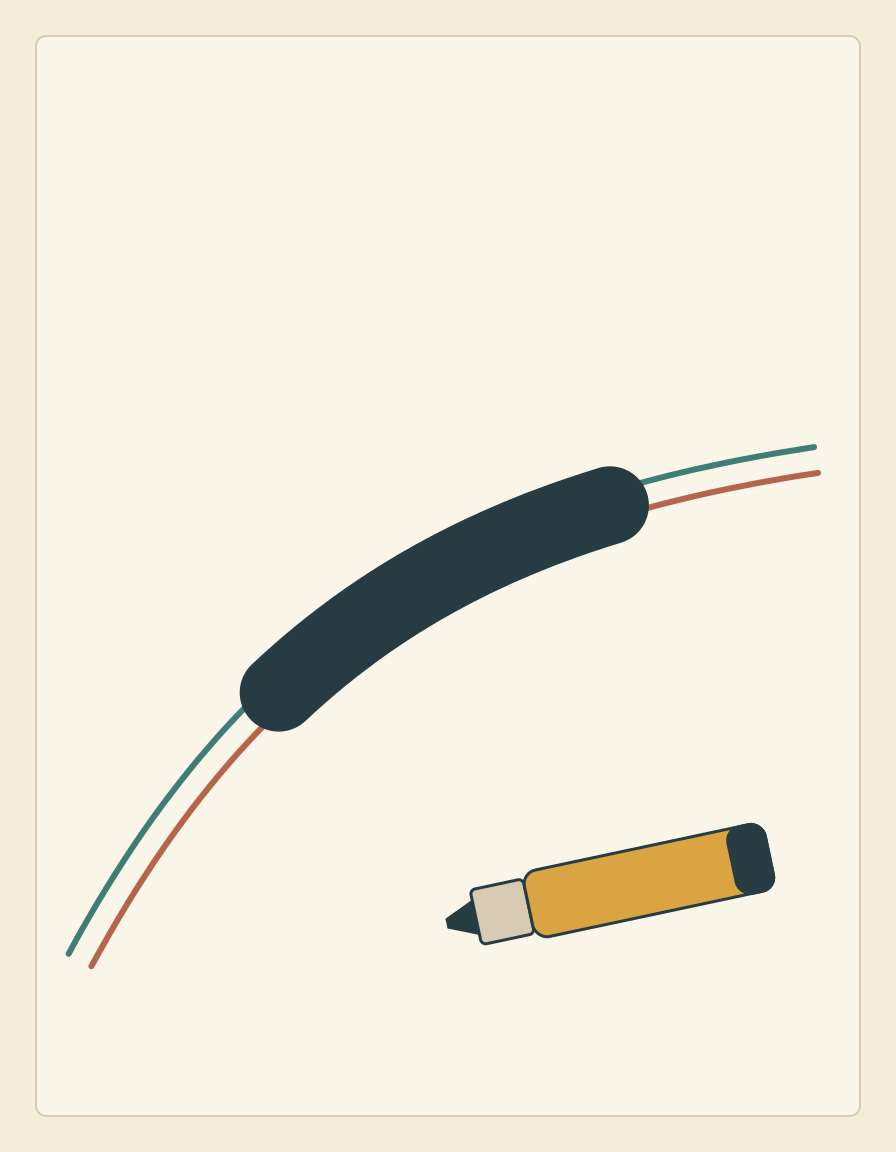
Imagine two very thin pencil lines drawn almost on top of one another. Viewed closely, you might be able to see the gap. Now trace over both with one thick marker. Along that stretch, you see just one line.
Did the lines become identical? No. Beyond the marker they are still two. The marker was simply too broad to show the difference.
At Aletheia, part of Meridian's Noema Institute, researchers Nadia Okafor and Tomas Ibarra have been facing a similar problem. Their instrument shows voltages to two decimal places. Their notebook has many careful entries, but a small difference can disappear between one displayed number and the next.
Aletheia has a far-reaching question about how unfamiliar signals might be received and distinguished from effects produced by an instrument. The name Psychic Amplifier Implant belongs to a proposed research ambition, not to a proven implant or psychic amplifier. For now, the team is working with an ordinary low-voltage electrical circuit.
The circuit is small enough to fit on a workbench. Its puzzle has proved surprisingly difficult.
What are the parts supposed to do?
The circuit contains two important pieces.
A resistor limits electrical current. A capacitor stores electrical charge. When the circuit is switched on, the voltage across the capacitor rises over time rather than jumping immediately to its final value. The resistor and capacitor together help determine how quickly that happens.
A label or a set of color bands gives a part's nominal value: the value it is described as having, not a promise that every example is exactly the same.
On Aletheia's board, the resistor was marked 100 kilohms (100 kΩ). The capacitor was marked 47 microfarads (47 µF).
In January, Okafor and Ibarra had recorded how the capacitor's voltage changed after they moved the switch. They could draw a predicted curve using these label values. But the labels had not yet been checked with a suitable meter.
What if the actual component values were a little different?
Can you measure a part without taking it out?
On February 25, the researchers checked what instruments were available. Their usual meter, AQ-M01, could read voltage but not capacitance or resistance. The workshop had another instrument, a bench multimeter they named AQ-M02, with both functions.
A multimeter is a device that can make several kinds of electrical reading. But attaching one to an assembled circuit creates a question of its own: what exactly is the meter connected to?
Imagine trying to weigh one book while it is still resting on a stack. If the scale supports the whole stack, its reading doesn't tell you the weight of that one book. You need to know what else is included.
An electrical measurement can have a similar difficulty. Other paths through a circuit may affect what the meter displays. So a reading made in place is not automatically a reading of one part alone.
Ibarra drew the board's connections before moving anything. They switched off the source, discharged the capacitor through the circuit and confirmed its voltage, then disconnected the voltage-meter and source leads. Afterward they examined whether there was another path across the capacitor. Their check found no steady resistive path within the range they tested. They had reasons to try reading the part while it remained on the board, not a guarantee that all possible effects had been excluded.
This was a carefully controlled bench procedure carried out by the research team. It is not an experiment to try with household electricity or an unknown circuit. The activity at the end of this issue uses only paper and pencils.
On February 26, AQ-M02 showed the following values:
| What they read | Value on the part's label | What the bench meter displayed |
|---|---|---|
| Resistor, still on the board | 100 kΩ | 98.62 kΩ |
| Capacitor, still on the board | 47 µF | 48.4, then 48.2 and 48.2 µF |
| Capacitor, with one leg lifted clear of its connection | 47 µF | 48.2 and 48.2 µF |
The lifted-leg comparison mattered. After recording the in-board readings, Ibarra temporarily disconnected one leg of the capacitor. Reading it this way removed that connection to the surrounding board. Both lifted-leg readings showed 48.2 µF, the same as the last two readings on the board. Then the leg was reinserted.
The part had not become a new capacitor, but the electrical contact was made again. The researchers explicitly recorded that the board had been reassembled. They did not pretend that an interrupted connection and its replacement were an untouched historical arrangement.

Does a more detailed number settle the question?
Not yet.
AQ-M02 had a record that its functions responded during a workshop check, but no calibration record. A calibration uses known references to examine how accurately an instrument reads. The researchers could report what its screen displayed, but they could not attach a trustworthy measurement uncertainty to those numbers.
The readings were useful for making new predictions. Okafor and Ibarra used the displayed component values and an estimate of how their earlier voltage meter affected the circuit to calculate another possible rising-voltage curve. They did not adjust the numbers to make the curve match their old observations.
Now they had two predictions: one from the labels, and one from the newly read parts.
At five seconds after the switch, one January notebook entry said 0.65 volts. Here is what the two calculations predicted for that same nominal time:
| At five seconds | Prediction before rounding | Shown to two decimal places |
|---|---|---|
| Curve made from the newly read parts | 0.648 V | 0.65 V |
| Curve made from the part labels | 0.652 V | 0.65 V |
| January notebook's actual meter display | — | 0.65 V |
The predictions differ by 0.004 volts. That is four thousandths of a volt. But the January notebook recorded hundredths of a volt. At this moment, both predictions become the same displayed value.
Neither calculation has vanished. The notebook simply cannot distinguish them here.
At some other moments the predictions round to different numbers. Could those moments pick a winner? Two seconds into the January 23 rise, the notebook matched the prediction from the read parts. About ten seconds into the January 26 rise, it matched the labels. They don't agree on a winner, and there is a bigger problem: time.
The researchers estimated that their hand timing could be out by about half a second. At five seconds the voltage is still climbing by about 0.07 volts each second. Reading half a second early or late would move the prediction from the read parts anywhere from about 0.61 to 0.68 volts. Beside that, a difference of 0.004 volts is tiny.
Across the old runs, the predictions were close enough that the records could not settle which component values better described the circuit. Human timing, rounded readings and the way the meter affected the circuit still mattered.
This is not a failure to do mathematics correctly. It is a discovery about what the existing evidence can answer.

The question moves from parts to time
The team now knows what this one uncalibrated bench meter displayed when connected to the parts. The next useful question is different.
When the January readings were made, someone moved a switch and another person noted the time. But the electrical instant when the voltage started to change was not independently recorded. A spoken cue and a hand-operated stopwatch are not an exact electrical timestamp.
That missing instant can matter when a capacitor's voltage is changing quickly.
Instead of taking still more readings of the same resistor and capacitor, the researchers need a way to record the actual electrical step and the readings against a common time reference. They also need an independent way to check the bench meter before treating its displayed numbers as accurate measurements.
Neither next experiment has been reported as completed here.
Sometimes the most important result of an experiment is not a bigger answer. It's that the question finally becomes precise enough to test.
Try it on paper: the missing difference
You need a pencil, paper and a ruler marked in millimetres. No electrical equipment is needed.
- Draw a horizontal line 10 centimetres long. Mark a point at 5.0 cm, then another at 5.4 cm. Keep both marks; they really are in different places.
- Imagine a very coarse measuring tool that reports only the nearest whole centimetre. Both positions would be reported as 5 cm. Write that reported value beside each mark.
- Now use the millimetre markings on your ruler. Can you distinguish the marks? What changed: the positions, or the information your tool can report?
- Try placing the marks still closer together. Where does it become difficult to see or measure their separation?
The ruler activity is an analogy, not a reconstruction of Aletheia's voltage experiment. It shows why two different possibilities can look identical to a tool that reports fewer steps.
For an extra challenge, ask: If your ruler's markings were printed incorrectly, would smaller marks alone make it accurate? That's the difference between a display showing finer steps and an instrument being properly checked.
Why this matters
Engineers want instruments that can distinguish changes that matter for their questions. More decimal places can help, but only when the instrument, method, timing and references justify them.
The same habit matters when investigating unfamiliar signals, building transport systems, or checking the history of a distant communication. Meridian also investigates extraterrestrial (ET) and extra-dimensional (ED) possibilities, meaning questions about possible origins beyond Earth and dimensions beyond ordinary descriptions of space. Those ideas are hypotheses, not results established by this simple circuit.
A good measurement may leave more than one explanation alive. Naming that limit is part of learning something real.
A small glossary
Capacitor: an electrical component that stores charge.
Resistor: a component that resists the flow of electrical current.
Nominal value: the labeled or expected value of a part, before its actual properties have been adequately checked.
Resolution: the smallest change a display or scale can show; not the same as accuracy.
Calibration: comparison with known references used to evaluate an instrument's measurement behavior.
Uncertainty: a qualified description of how much a measured result may reasonably differ from the quantity being measured.
Electrical step: a change in an electrical input whose beginning can be used as a timing reference.
Follow the research
- The circuit under the meter
- Two rises we already had
- Reading the parts where they stand
- What changes when you look?
- What makes a second check independent?
The illustrations and diagrams are authored drawings, not photographs or newly collected measurements.